Top Benefits of Switching to LED Lighting for Your Commercial Property

January 12, 2026

Why LED Lighting Makes Business Sense

In today’s competitive business environment, every dollar counts — and so does every impression you make on your customers, employees, and visitors. Upgrading to LED lighting is one of the smartest investments you can make for your commercial property. Beyond just saving energy, LEDs offer a wide range of benefits that impact your bottom line, operational efficiency, and the overall atmosphere of your space.

1. Unmatched Energy Efficiency

One of the most significant advantages of LED lighting is its exceptional energy efficiency. LEDs use up to 75% less energy than traditional incandescent, fluorescent, or metal halide bulbs. This translates into substantial savings on your utility bills, especially for businesses that operate large spaces or require extensive outdoor lighting, such as warehouses, offices, shopping centers, and parking lots. Switching to LED not only reduces your carbon footprint but also aligns your business with growing environmental and sustainability expectations from customers and regulatory bodies.

Call Now

2. Dramatically Longer Lifespan

LED lights are built to last. A typical LED fixture can last 25,000 to 100,000 hours, depending on usage and quality. This is significantly longer than traditional bulbs, which often burn out after just 1,000 to 5,000 hours. Fewer replacements mean reduced maintenance costs, less downtime, and a lower total cost of ownership.


In fact, many Illinois businesses find that the initial investment in LED lighting pays for itself within just a few years through energy savings and maintenance reduction.

3. Reduced Maintenance and Replacement Costs

Maintaining traditional lighting systems can be costly and labor-intensive, especially when frequent bulb replacements are required. LEDs minimize maintenance efforts and expenses. With longer lifespans and more durable construction, LEDs are highly resistant to vibration, shock, and extreme temperatures — making them ideal for both indoor and outdoor applications.

Call Now

4. Superior Light Quality

LEDs deliver bright, uniform lighting that enhances visibility and aesthetics across commercial spaces. Features like better color rendering (high CRI ratings), instant-on capabilities, and adjustable color temperatures allow you to customize the look and feel of your environment, whether you’re lighting a retail showroom, office floor, or exterior parking area.


Improved lighting also boosts employee productivity, customer satisfaction, and overall safety — all key factors in a successful operation.

5. Smart Lighting Capabilities

Modern LED systems often come with advanced control options such as:


  • Motion sensors
  • Dimming systems
  • Programmable timers
  • Daylight harvesting features


These technologies provide even greater energy savings and allow businesses to optimize lighting usage based on real-time needs, enhancing convenience and security while lowering costs.

Financial Incentives Available for Illinois Businesses

Making the switch to LED lighting is even more attractive when you consider the rebates, tax credits, and utility incentive programs available to businesses across Illinois. Illinois Lighting can help you identify and apply for eligible programs to offset your upfront costs.

Frequently Asked Questions (FAQ)

  • How quickly will I see a return on investment (ROI)?

    Most businesses see a full return on their LED lighting investment within 1–3 years due to combined energy and maintenance savings.

  • Is LED lighting suitable for outdoor commercial spaces?

    Absolutely. LEDs perform exceptionally well outdoors, offering bright, reliable light even in extreme weather conditions typical of Illinois winters and summers.

Ready to lower your energy costs and enhance your property’s appeal?

Contact Illinois Lighting today for a free LED lighting consultation!

Call Now
August 24, 2026
If you are still running T12, T8, or T5 lamps, fall budgets make now the right time to choose a clean, compliant path to LED. The right choice reduces energy and maintenance without creating safety or code headaches later. This guide breaks down the three LED tube types, when to pick new LED panels or troffers, what to watch out for with ballasts and emergency circuits, and how to plan labor with minimal downtime. No myths, no surprises, just a practical path forward. Illinois Lighting has supported commercial and industrial upgrades since 1999 with full product supply, code-aware guidance, and turnkey coordination. Use this as your starting point, then tap our team for a scoped plan and documented install. Your options for tube-to-LED conversions Most fluorescent-to-LED projects pick one of three tube approaches. All three can be safe and code compliant when installed to listing and manufacturer instructions.  Type A, plug-and-play: Works with a compatible fluorescent ballast. You keep the ballast, swap lamps. Type B, ballast-bypass: Line voltage runs directly to the lamp, ballast removed or permanently disconnected. Type C, external driver: Fluorescent ballast removed, remote LED driver powers LED tubes designed for that driver. Type A, plug-and-play Pros: Fastest swap with lowest immediate labor. Ideal for occupied spaces where shutoff windows are tight. Keeps existing lamp holders and wiring intact. Easiest path if you just changed ballasts recently and want to leverage them. Cons: Ballast adds failure points and parasitic wattage, so efficiency and lifetime savings are lower than Types B or C. Compatibility matters. Not every LED tube works with every ballast. Expect potential nuisance trips or flicker if mixed. You are still buying and maintaining ballasts. Best fit: Short-term bridge strategy, multi-tenant sites where access is limited, or when a facility wants a phased plan. Type B, ballast-bypass Pros: Removes the ballast, improving efficiency and eliminating a major failure item. Broad product availability, including options for single-end or double-end power. Cons: Requires fixture rewiring and labeling. Incorrect wiring can create shock hazards. Single-end power versions need strict polarity control. Double-end power reduces that risk but still needs careful identification. Some manufacturers disallow enclosed or gasketed fixtures due to heat. Verify ratings. Best fit: Cost-focused retrofits where long-term maintenance and energy savings outrank the speed of a ballast-keeping swap. Safety musts: Use UL-listed retrofit lamps intended for line-voltage applications in that fixture type. Apply supplied labels inside the housing to warn of line voltage at lamp holders. Type C, external driver Pros: Highest system efficiency and best dimming and control compatibility. Driver can be remote-mounted and serviced like a component in a fixture. Often the most future-proof for networked controls, emergency drivers, and lumen maintenance strategies. Cons: More parts to source and higher upfront labor than Type A. Requires space for a driver and careful wiring. Best fit: Premium office, education, healthcare, and industrial sites that want strong controls integration and predictable maintenance. When to choose new LED panels or troffers Tubes are not always the best answer. Full LED fixtures make sense when: Lens, door frames, or housings are yellowed, brittle, rusty, or bent. You want clean, uniform light and lower glare typical of modern LED panels and high-performance troffers. Controls are a priority. Many fixtures accept integral sensors or network nodes out of the box. You need sealed, NSF, or specialty ratings. Purpose-built fixtures are simpler to document and maintain. If more than a third of fixtures are in poor condition, or if photometrics show uneven light that tubes cannot fix, replacement panels or troffers typically win on lifecycle cost. Code, listings, and rebates in plain language UL: Look for UL or ETL listing appropriate to the configuration. For Type B and Type C, ensure the retrofit kit or lamp is listed for the intended wiring method and apply all labeling. DLC: DesignLights Consortium listings are commonly required for utility incentives. Not all tube types or fixtures are DLC-listed, so confirm model numbers and categories. Emergency lighting: If a fixture is part of an egress or life safety path, include an LED-ready emergency driver or a dedicated emergency fixture. Verify runtime and testing requirements with your authority having jurisdiction. Enclosed and high-heat locations: Only use products rated for enclosed fixtures or elevated ambient temperatures as applicable. Illinois Lighting helps you select UL-listed and, where applicable, DLC-listed products and provides cut sheets, wiring diagrams, and labels that match the installed condition. Avoid these common pitfalls Mixing lamp types on one circuit. Keep a space consistent to prevent flicker, color mismatch, and maintenance confusion. Assuming any ballast will work. For Type A, check the ballast compatibility sheet. For aging ballasts, plan for proactive replacement or move to Type B or C. Ignoring enclosed fixtures. Heat can shorten LED life. Select lamps and drivers rated for enclosures, or replace with sealed LED fixtures. Skipping emergency strategy. Identify which fixtures must remain on emergency power and solve for them in the base design. Leaving fixtures unmarked after a bypass. Proper labels protect future technicians and keep you compliant with listing instructions. A quick worksheet to scope your retrofit Walk each area with a notepad or spreadsheet and capture: Count fixtures by type and size. For troffers, note 1x4, 2x2, or 2x4 and lamp count. Identify ballast types. Electronic or magnetic, instant-start or program-start, and the number of lamps served. Note condition. Yellowed lenses, missing reflectors, broken tombstones, or water/dust exposure. Record heights and access issues. Lifts needed, aisle clearance, ceiling obstacles. Flag emergency circuits and control zones. Mark any red-labeled circuits and rooms with sensors or schedules. Pick windows for work. Estimate how many fixtures per hour can be changed without disrupting operations. Illinois Lighting turns this worksheet into a labor plan, coordinates material delivery, and stages work to minimize downtime. How Illinois Lighting scopes labor and minimizes downtime We audit and photo-document representative spaces, confirm ballast or driver types, and verify controls and emergency circuits. We build a zone-by-zone schedule that fits building hours and production, often sequencing by quadrant or floor. We pre-label fixtures and kit components so installers move quickly and consistently. We commission controls with documented setpoints and train your team so savings and safety persist. For local support, explore resources for commercial lighting contractors in Aurora or find Aurora LED bulbs when you need quick interior swaps. For broader projects, our team supports North Aurora LED retrofit installations with full product supply and coordination. Helpful links: See our Aurora LED lighting support for project coordination: https://illinoislighting.com/aurora-led-lighting-contractors Browse Aurora LED bulbs for fast replacements: https://illinoislighting.com/aurora-led-bulbs Learn how we install lighting controls in North Aurora: https://illinoislighting.com/lighting-control-services/ Start with a North Aurora LED retrofit company overview: https://illinoislighting.com/service-areas/north-aurora/ FAQ Can I directly replace fluorescent tubes with LED? Yes, with Type A plug-and-play lamps on a compatible ballast. For maximum efficiency and fewer failure points, consider Type B or Type C. Do I need to bypass the ballast, and when is it recommended? Not required for Type A. Recommended for long-term savings or when ballasts are failing. Use UL-listed Type B or move to Type C with an external driver. When are new LED panels better than tubes? When fixtures are in poor shape, when you want lower glare and integrated controls, or when enclosure and specialty ratings are needed. What certifications should I look for? UL or ETL listing to match the wiring method, and DLC for many rebate programs. Keep product model numbers exact. How does Illinois Lighting minimize downtime? By auditing first, pre-kitting materials, scheduling by zone, coordinating with your hours, and commissioning controls with documentation. Summary and next step Choose Type A for speed, Type B for simple efficiency and fewer failures, or Type C for premium efficiency and controls. If housings are tired or you want better visual quality, move to new LED panels or troffers. Validate UL listing, check DLC for incentives, plan emergency coverage, and label everything. Illinois Lighting is ready to help you scope, supply, and coordinate a compliant upgrade that fits your calendar. Call 630-844-5060 or email info@illinoislighting.com for a free estimate and a no-drama retrofit plan.
July 24, 2026
Mid-year energy targets are coming due, and for many facilities the fastest wins are sitting in plain sight. Lighting controls turn good LED upgrades into great ones by trimming kWh when spaces are empty, when sunlight is available, and when output can be right-sized for the task. The result is energy savings that persist without constant attention. This guide explains the core control types in clear terms, where each one excels, and how to apply them in offices, warehouses, corridors, restrooms, and parking structures. We will also cover retrofit paths for existing buildings, why commissioning and training matter, and how dashboards help you prove ROI and plan maintenance. If you need a practical plan tailored to your building, Illinois Lighting has the experience and teams to design, supply, commission, and support integrated control solutions for commercial and industrial spaces across North Aurora, Aurora, Geneva, and the greater Chicagoland area. The big five controls, explained Occupancy and vacancy sensing: Sensors turn lights on when people are present and off after a timeout. Occupancy turns on automatically when motion is detected. Vacancy requires a manual on, then turns off automatically later. Both reduce wasted run hours. Scheduling: Time-based control that turns lights on and off, or dims them by area, based on a calendar. Effective for predictable hours, holidays, and after-hours dimming. Daylight harvesting: Photosensors trim or switch off electric light when natural light meets your target levels. Best near windows, skylights, and dock doors. High-end trim: Sets a maximum output below 100 percent to lock in savings without visible loss. Many spaces are overlit; capping to 80 to 90 percent can save energy quietly every hour. Task tuning: Calibrates light levels to the actual task need by zone. For example, open office aisles might run at 40 footcandles while collaboration zones stay at 30. Together, these strategies often deliver 20 to 50 percent additional savings on top of an LED retrofit, depending on hours, layout, and discipline with commissioning. Where each control works best Open offices: Pair scheduling for base hours with occupancy sensors by zone. Add daylight harvesting along window lines and high-end trim building-wide. Task tuning helps balance screens and meeting areas. Conference rooms: Vacancy sensing avoids lights turning on for passersby. Add a simple scene control with presets for presentation, collaboration, and video calls, each with trimmed maximums. Warehouses and plants: Use aisle-based occupancy with longer timeouts on main travel paths and shorter in low-traffic zones. High-end trim and task tuning stabilize light levels. Daylight harvesting near skylights and dock doors reduces eye strain from sun swings. Corridors and stairwells: Occupancy with bi-level dimming keeps safety lighting at a low background level, then rises when someone enters. Restrooms: Vacancy or occupancy with short timeouts works well. Consider ultrasonic or dual-tech sensors to detect minor motion. Parking structures and lots: Scheduling plus motion-dimming groups by drive aisle maintain visibility while trimming output during low-traffic hours. Exterior daylight harvesting helps during bright mornings and late afternoons. Retrofit vs. new build: your practical pathways Existing buildings: Networked wireless controls are usually the fastest way to retrofit without opening walls. You can add fixture controllers, battery or line-powered sensors, and gateways that create a building network. This approach scales from a few rooms to a multi-floor portfolio and often slots into your existing LED fixtures. If you plan to install lighting controls in North Aurora and want a clear retrofit roadmap, see our service overview for integration and commissioning support at Illinois Lighting. Renovations and new builds: Wired controls can be cost-effective when walls are open and conduit is planned. Digital addressable lighting interfaces and low-voltage networks provide robust, code-compliant control with strong signal reliability. These systems are ideal when sequences are complex or when you are coordinating with an energy management system. Can controls be added to existing fixtures during a retrofit? In most cases, yes. Many LED fixtures accept in-fixture controllers or external nodes, and older housings can accept retrofit control kits. During audits, Illinois Lighting confirms driver compatibility, space for sensors, and code requirements before recommending a control package. Fastest payback: start simple and scale Which controls deliver the fastest payback? In most facilities, occupancy or vacancy sensing and high-end trim top the list because they are simple, low-friction, and always working. Scheduling is close behind when hours are predictable. Daylight harvesting offers strong value in spaces with meaningful daylight. Task tuning locks in calibrated savings in offices and production zones. For example, pairing high-end trim with occupancy in a warehouse aisle can cut thousands of hours of unnecessary runtime annually, delivering quick returns without disrupting operations. Where should occupancy sensors be prioritized? Start with intermittently used spaces with long hours: restrooms, conference rooms, private offices, storage rooms, back corridors, and low-traffic warehouse aisles. Then expand to open offices and production zones with thoughtful timeouts and grouping to avoid nuisance on and off events. Commissioning that protects your savings How does commissioning impact performance and savings? Proper commissioning sets the timeouts, sensitivity, trim levels, schedules, and group logic to match how your teams really use the space. Without it, systems often underperform because defaults are too conservative, or because settings drift during season changes or layout shifts. Illinois Lighting completes commissioning with documented setpoints, zone maps, and user notes so you know exactly how the system is set and how to adjust it safely later. Training facility teams to keep systems optimized What training do facility teams need? Focus on three areas: Daily use: How to use wall controls, scenes, overrides, and daylight zones without defeating savings. Adjustments: How to change a timeout or trim level in approved ranges, and how to document changes. Maintenance and alerts: How to read dashboards, acknowledge sensor faults, and plan replacements. Illinois Lighting provides quick-start guides and hands-on walkthroughs so the savings persist and small issues are resolved before they grow. Data, dashboards, and proving ROI Modern control platforms show occupancy heat maps, runtime reports, and kWh estimates by zone. Dashboards help you prove ROI to finance, validate utility incentives, and spot underused spaces or sensors that are too sensitive. Maintenance teams can use runtime hours to schedule cleanings or target lamps and drivers that are nearing end-of-life. Over time, these insights inform staffing, safety reviews, and capital planning. If you are exploring exterior and parking updates, our Aurora LED lighting resources outline common retrofit combinations for area lights, wall packs, and canopy fixtures, including motion groups and schedules that reduce after-hours load while maintaining visibility. For HID-to-LED conversions where rebates matter, review our guidance on DLC-listed replacements and rebate documentation for Aurora projects so controls and fixtures work together. Quick FAQ Which controls pay back fastest? Occupancy or vacancy sensing and high-end trim usually deliver the quickest returns. Scheduling and daylight harvesting add more savings based on your hours and daylight. Where should occupancy sensors go first? Prioritize intermittently used rooms, corridors, restrooms, conference areas, and low-traffic warehouse aisles, then expand across open areas. Can I add controls to existing fixtures? Yes in many cases. Wireless nodes, in-fixture sensors, and retrofit kits can be added to compatible LED fixtures. An audit confirms driver and sensor fit. Does commissioning really matter? Yes. Correct timeouts, trims, and grouping often determine whether you capture the expected savings. Commissioning also reduces complaints and overrides. What training keeps systems optimized? Teach users basic controls and scenes, empower facility staff to make limited adjustments with documentation, and show maintenance teams how to read dashboards and alerts. Getting started A short audit is often enough to map zones, confirm fixture compatibility, and outline a phased retrofit plan. Illinois Lighting has supported commercial and industrial clients since 1999 with design, supply, commissioning, and post-install support. If you are planning a mid-year push, our team can help you prioritize quick wins and set up a control strategy that lasts. For regional support near Fox Valley, explore how our commercial lighting contractors in Aurora approach integrated LED and controls. If you are planning controls plus a fixture update in Kane County, see options to install networked controls and coordinate with energy management systems in Geneva. Summary: The controls that save the most are the ones that match how your space actually runs. Start with occupancy or vacancy sensing, high-end trim, and schedules. Add daylight harvesting and task tuning where light quality or daylight conditions call for it. Commission carefully, train your team, and use dashboards to verify results. When you are ready to upgrade or expand, Illinois Lighting is here to help design and supply a right-sized controls plan that delivers reliable savings.
June 25, 2026
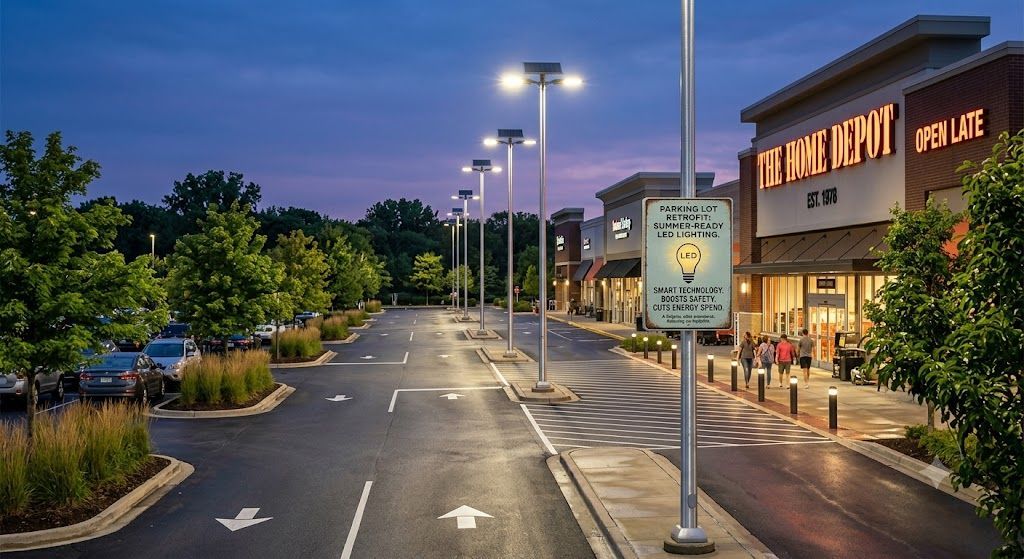
Longer daylight and busier evenings make summer the right moment to tune up your exterior lighting. If your parking lot is still running high-pressure sodium or metal halide lamps, you are likely overspending on energy and maintenance while fighting glare, dark spots, and camera washout. This guide walks property and facility managers through a practical retrofit path to LED. You will see how to use the right optics and color temperature, add smart controls that trim after-hours kWh, and plan an installation with minimal disruption. We close with a quick scenario from a Chicagoland retail lot to make the ideas concrete. Why retrofit HID lots and sites to LED HID technologies like high-pressure sodium (HPS) and metal halide were the standard for years, but LEDs typically cut energy use by 40 to 70 percent depending on wattage, optics, and controls. A 400 W metal halide shoebox that draws around 455 W with ballast can usually be replaced by a 150 to 200 W LED area light while maintaining or improving visibility. With motion dimming and nighttime scheduling, many sites see additional savings on top of the fixture efficiency. Maintenance drops significantly because quality LED fixtures offer long lifespans with L70 ratings of 50,000 to 100,000 hours. That means fewer bucket truck trips, fewer lamp and ballast changes, and less downtime in busy seasons. LEDs are instant-on in any temperature, so you avoid restrike delays after power blips and you can confidently use sensors. From a safety and security standpoint, LEDs improve uniformity and color rendering, which helps drivers, pedestrians, and cameras see detail. That improved clarity supports monitoring and shortens the time it takes eyes and lenses to adapt when moving from brighter to darker areas. A retrofit path that works Most exterior upgrades follow a straightforward path from HID to LED: Pole-mounted area lights: Replace shoebox heads with new LED area fixtures or use pole light retrofit kits when the existing housing is sound. Wall packs: Swap to full-cutoff LED wall packs for perimeter and facade lighting, or use wall pack retrofit kits where the housing must remain. Canopy lights: Convert under-canopy HIDs at entries and drive-throughs to LED canopy fixtures with sealed optics and glare control. Flood and sign lights: Replace asymmetrical floods and sign lamps with LED floods matched to throw distance and tilt. In many cases you can retrofit existing poles and heads instead of full replacement. A site audit will confirm pole condition, bracket compatibility, wiring state, and whether the existing housing supports safe thermal performance for a kit. Where housings are corroded, gaskets have failed, or optics are outdated, full fixture replacement is the safer and often more energy-efficient choice. If you manage properties in the Fox Valley, our team supports audits, specification, and installation coordination. For help right away, you can connect with commercial lighting contractors in North Aurora through our main page, or explore Aurora LED lighting resources if your portfolio includes properties next door. Choose CCT and optics that improve visibility without glare Color temperature and beam distribution drive both comfort and safety. Color temperature: For residential-adjacent or mixed-use properties, 3000K to 4000K keeps a warm to neutral appearance that limits perceived glare and neighborhood complaints. For retail centers, industrial sites, or busy arterials, 4000K to 5000K enhances contrast and camera clarity. Many campuses standardize on 4000K for a balanced look across zones. Optics and distribution: The goal is uniform coverage with minimal hot spots and dark patches. Use Type III or Type IV optics to push light forward for perimeter rows, and Type V for central poles where 360-degree symmetry is needed. Proper tilt and mounting height matter as much as fixture wattage. When optics are matched to spacing, you often step down wattage and still gain visibility because uniformity improves. Glare control matters for drivers and cameras. Favor fixtures with diffusing lenses or cut-off shields where sightlines are critical. Avoid tilting floods too high; even small angle changes can create veiling luminance for drivers and produce halo artifacts in CCTV. Controls that lower costs while supporting safety Motion sensors, scheduling, and dimming are the backbone of after-hours savings. The winning combination is simple: Scheduling: Set baseline on times to match operating hours, then dim to a late-night level rather than switching off. Many properties hold at 30 to 50 percent after closing, then step back up before opening. Motion sensing: Use integral or pole-mounted sensors to bring zones to full output only when activity is detected. Zoning reduces false triggers and avoids lighting the entire lot for one vehicle. Dimming: Pair 0 to 10 V dimming or networked controls so fixtures ramp smoothly. Soft transitions reduce nuisance to neighbors and help cameras maintain exposure. These strategies often trim another 20 to 40 percent of kWh beyond the fixture swap, depending on hours and traffic patterns. Commissioning is key. We tune timeouts, sensitivity, and grouping so areas near entries remain inviting while remote edges save aggressively. If you are adding controls to multiple sites, our team can help you plan, supply, and install lighting controls in North Aurora with documentation for operators. Camera compatibility and site security CCTV performance improves when vertical illumination and uniformity are prioritized. Choose a consistent CCT across the site, avoid mixed spectra near entrances, and keep minimum light levels steady so automatic exposure in cameras does not hunt. Shield or select low-glare optics near cameras to prevent lens flare. If you use analytics for license plates or people detection, keep contrast reliable by limiting hot spots near poles and bright signs. Mini scenario: Chicagoland retail lot A suburban retail center west of Chicago ran 400 W metal halide shoeboxes on 25-foot poles with several wall packs along the storefronts. The property team faced frequent lamp changes, color shift, and dark corners that frustrated tenants. After an audit, the plan specified 150 W LED area lights with Type III optics on perimeter poles and Type V in the center rows, standardized at 4000K. Full-cutoff LED wall packs replaced the storefront HIDs. Integral motion sensors were grouped by aisle, with schedules dimming to 40 percent from 11 p.m. to 5 a.m. The loading dock canopy received sealed LED canopy lights rated for weather and washdown. Results included roughly 55 percent energy reduction at the fixtures, plus an additional 25 percent cut from nighttime dimming and motion. Uniformity improved, eliminating bright rings under poles and dark gaps between them. The security vendor reported cleaner camera footage with fewer washed frames. Maintenance calls dropped to almost zero in the first year. If your portfolio includes nearby properties, you can review DLC-listed HID-to-LED replacement guidance for Aurora projects, including rebate considerations. Our local team also supports tenants who ask about Aurora LED bulbs for quick interior swaps. Installation with minimal disruption Illinois Lighting coordinates installation around store hours and traffic. Typical measures include: Phased work zones that keep primary drives open. Night or early morning pole work scheduled to avoid peak parking. Pre-staged lifts, fixtures, and hardware to shorten on-site time. Commissioning after dark so aiming, dimming, and sensor zones are verified under real conditions. As an independent distributor and project manager, we align product lead times with your calendar, collaborate with your electrical contractor, and remain available for adjustments after go-live. That is how we keep upgrades easy from start to finish. FAQ What are the advantages of retrofitting HID parking lot lights to LED? Expect big energy savings, better uniformity and color rendering, instant-on performance, and far less maintenance. LEDs also support advanced controls that HIDs cannot handle well. Which CCT and optics reduce glare and improve visibility? Use 3000K to 4000K for residential-adjacent sites and 4000K to 5000K for retail or industrial. Match optics to layout, typically Type III or IV on perimeters and Type V in central rows, and favor full-cutoff or shielded designs to limit glare. How do motion sensors and schedules lower costs? They dim lights when areas are inactive, then raise levels on demand. Combined with time-based dimming after hours, this often stacks an extra 20 to 40 percent savings beyond the fixture swap. Can we retrofit existing poles and heads instead of full replacement? Yes, if poles, brackets, and housings are structurally sound and thermally suitable. Otherwise, full fixture replacements are safer and often deliver better uniformity and efficiency. How does Illinois Lighting handle installation with minimal disruption? We phase work, schedule off-hours, pre-stage materials, coordinate with your team, and commission settings after dark so the site looks right on night one. Next steps Summer sets the tone for the rest of the year. If you want a safer, brighter lot that costs less to run, we can help you plan the right mix of LED fixtures, optics, and controls, then manage a smooth install. For local support, start with our North Aurora page for north aurora LED lights and retrofit services, or connect with commercial lighting contractors in Aurora if your properties span both cities. You can also reach our team at 630-844-5060 or info@illinoislighting.com to request a free estimate and a quick controls plan tailored to your site.